*The decision bottleneck, delegation that only half happens, and plans that survive a scaling business*
There is a point in most young companies, usually somewhere between 6 and 12 people, where the way things have always been done quietly stops working. Nobody resigns and no client walks out. The work simply starts to back up, decisions take longer than they should, and the founder finds they are busier than ever while the company moves more slowly than it did a year ago.
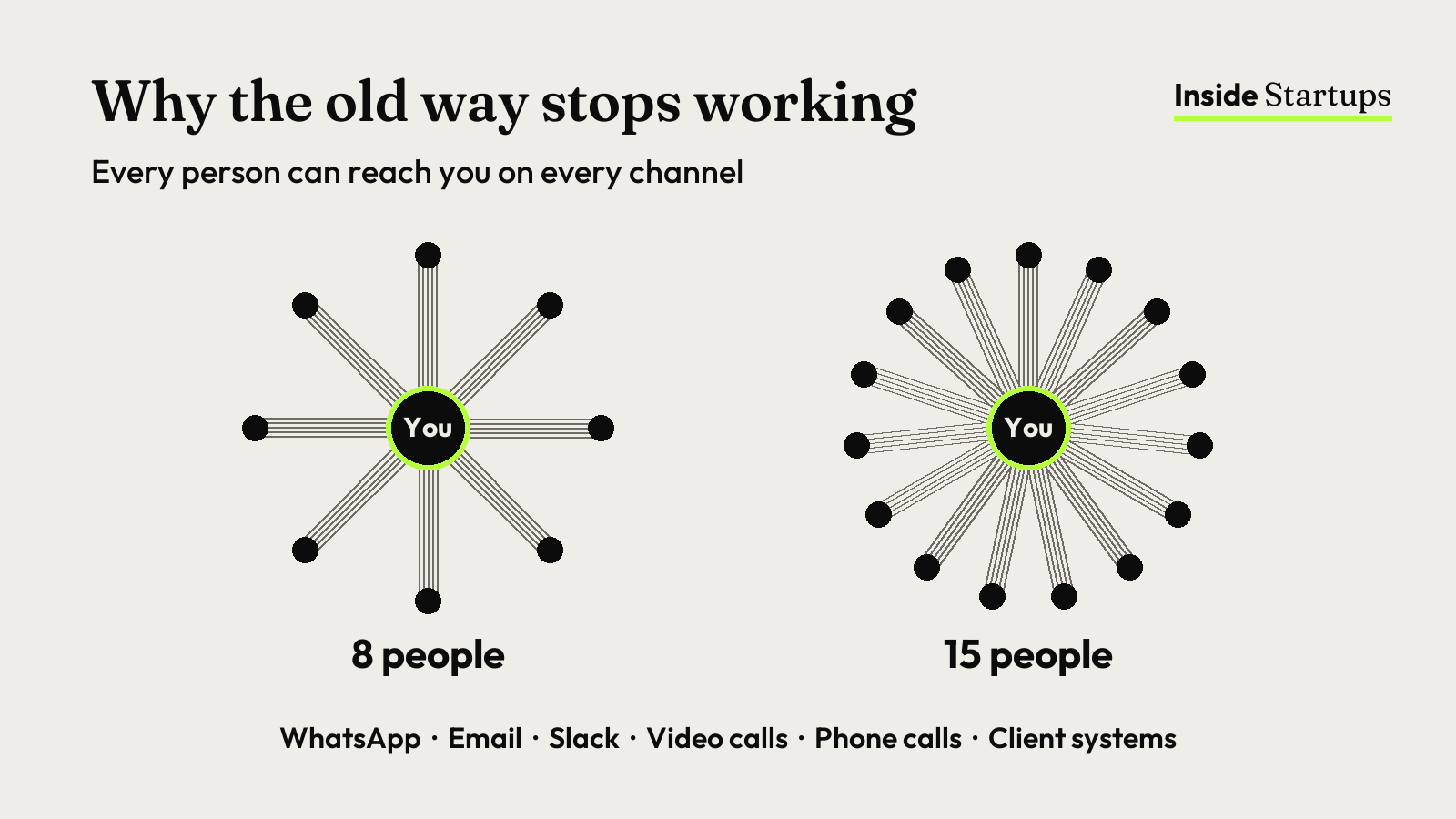
The cause is mechanical rather than personal. The way of working that served a team of 6, where everyone moved quickly by talking across a desk, was never built to carry 15. Think about how many ways each person in the business can reach you. There is probably WhatsApp, email and a tool like Slack, which many tech companies use, or Discord or an equivalent, and then there are video calls and actual phone calls, so even inside the company there are multiple lines of communication. When you are serving clients, they may have their own channels too, because they prefer you to come into their systems, which means even more. Before you know it, people can reach you in many different ways, and if you have grown from 8 people to 15 without delegating responsibility, all 15 are now trying to contact you across every one of those channels. That suddenly turns into a nightmare for the founder, who used to hear about everything and now hears about it late, while in most cases still expecting to sign it off.
I coach a lot of companies through exactly this stage, and the first place the strain shows is almost always decision-making. So this issue is about that bottleneck: why it forms, why delegation on its own rarely clears it, and why the plan to fix it has to keep moving. Next week I will look at the other half of the problem, which is why headcount is no longer the scoreboard.

The bottleneck usually sits with the CEO
When a company starts to stall at this size, everything still tends to run through the CEO. Sometimes that is because proper delegation has never been put in place, so nobody has clear authority to make decisions up to a defined level of risk. More often than founders like to admit, the delegation exists on paper and nobody uses it. The people who now own those decisions have never owned them before. They have not yet grown into the role in front of them, they are worried about getting it wrong, and so they quietly hand the decision back to the founder, which puts everyone back where they started.
Autonomy given in one breath and taken back in the next
The harder version is when the founder is the cause. The CEO tells the team they have autonomy and decision-making power, and the following week slaps someone down for making a decision without discussing it first. In my experience that is rarely deliberate. Sometimes the founder simply is not used to letting go. Sometimes it is a question of trust. And sometimes their mood changes with the wind, because they are carrying more pressure than they are equipped to carry.
I see this most often in CEOs running on fatigue, long hours and too much on their plate, trying to do too many things at once. They forget what they said and what they approved, and when that catches up with them it can come out as frustration aimed at the team around them. That team, often with a lighter workload, is looking on and thinking that they said one thing on Tuesday and changed their mind again on Friday. Try to point that out to a CEO in that state and the reaction depends heavily on maturity, and I mean maturity in how they operate rather than their age. Some take it well and others do not.
It is worth being plain about why some founders hold on so tightly. If you have put your own money into a business and been in control of it for years, you worry that things could slip off a cliff the moment you let go. Sometimes they already have, and the reason you are holding everything is that you do not believe the people around you can do the job better than you. Until that habit changes, no amount of process will fix the bottleneck, because the bottleneck is sitting in the chair at the top of the org chart.
Delegation only works if you have the right people
There is a great deal of good material out there, from Simon Sinek and others, making the case for delegating responsibility, leaning into your people and trusting them. I agree with it, providing you have the right people. If you do not, handing them every decision will not help you and may well make things worse.
Here is a pattern I see regularly, and it is not confined to sales. It shows up in marketing, operations, product and finance just as often, but sales makes the clearest example. Sales are not going well, and the founder has been doing most of the selling. There is a salesperson on the team who comes from business-to-business enterprise sales, but the company sells to consumers. They used to sell a service, and now they are selling a product. The only thing their background has in common with the role is the word sales. Does it make sense to hand that person full responsibility for revenue, wrap some key performance indicators and a process around them, and declare the problem solved? It does not. The same is true of a finance lead from a large corporate asked to run the books of a twelve-person company with no finance team underneath them, or an operations manager who has only ever followed a process being asked to design one from scratch. Either the people around them support and train them until they can do the job properly, or they need replacing. A young company that is scaling rarely has the budget or the time to train someone into a role they were never suited to. The real fix was at the hiring stage.
So when I look at a company going through this, whichever team it is, I do not start by picking someone to empower and making them accountable. I start with what they have proven. What is their track record? Are they capable of this role, and do they actually want it? None of that shows up in a spreadsheet, and it does not come out of an AI tool that runs a quick assessment of your business and tells you to do A, B and C. It comes from having been in the room for a lot of these decisions.
Culture decides whether any of it holds
When I work with a client through this stage, I look at the people, the process, the systems, the organisation design, and where AI and automation can take on work. I also look hard at the culture, because I want to know whether the improvements will hold once they land. Is this a company where change gets bought into, or one where it does not matter what you implement because the CEO will keep control of everything regardless? Who are the champions who will push the change and own it? If those people do not exist, or the founder has not yet changed how they operate, the most elegant operating model in the world will sit unused.
Plans that survive contact with a scaling business
Early in my career I worked on organisation-wide assessments for John Lewis and Waitrose, and later, at Streamr, I helped design the operating model as the company grew from 5 people to more than 30 after its raise. A lot of the transformations I saw back then were fixed plans in a deck: do A, B and C, trim this much off your cost base, grow revenue, off you go. In a scaling business that approach does not survive, because the business changes faster than the deck.
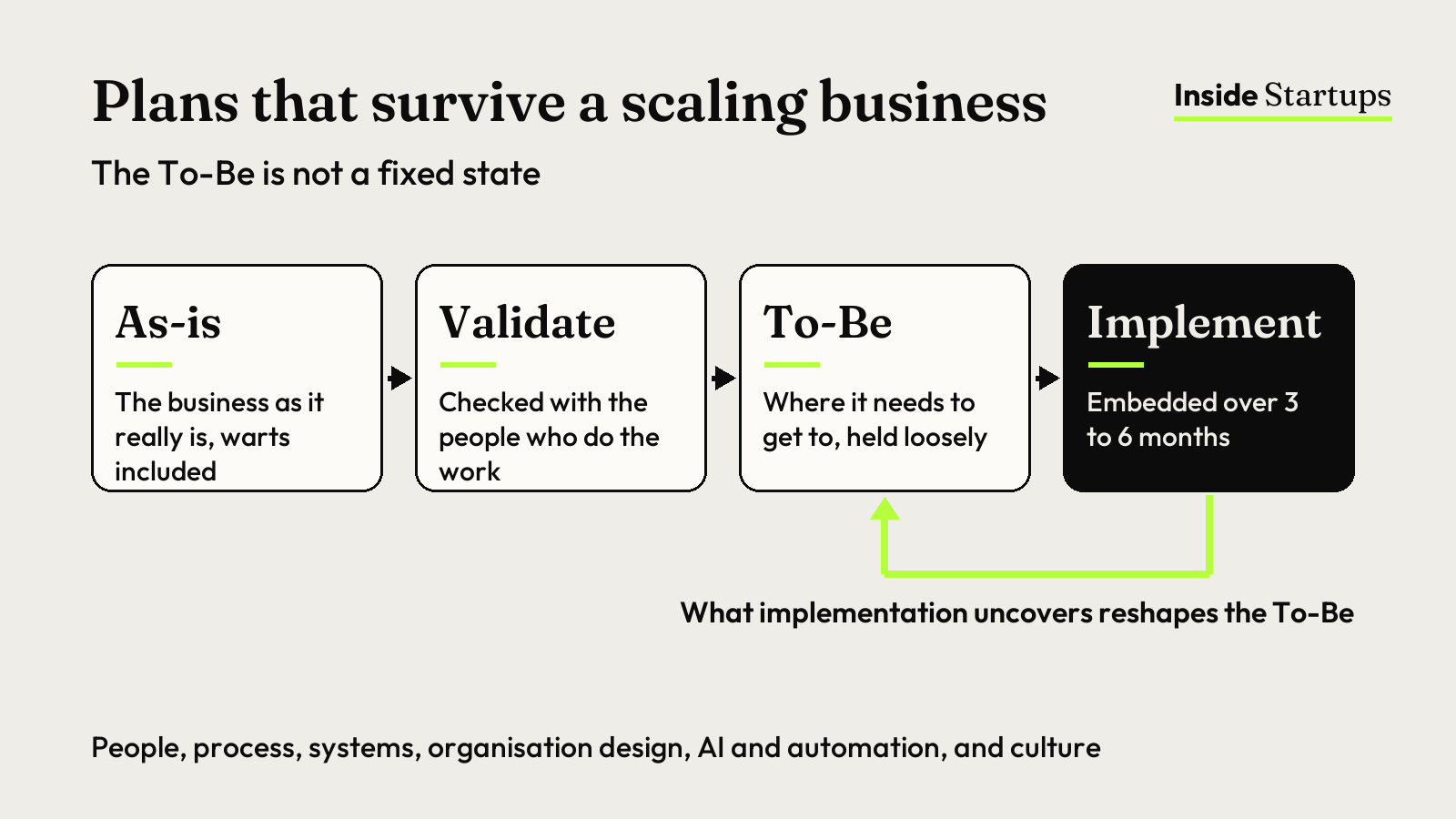
What works better is a simple sequence: an honest As-is picture of the business, warts included, validated with the people who actually do the work, because they will tell you where the picture is wrong; then a To-Be view of where the business needs to get to; and then implementation. The difference is that the To-Be should not be a fixed state. In my experience far more comes out during implementation than in any assessment, so the implementation needs enough flexibility for the To-Be to evolve as things change, adjusted as you go over 3 to 6 months of embedding until the changes properly stick.
One of the reasons I left the world of consultancy in the early part of my career was that I did not believe the To-Be plans being implemented were right for some of the clients we were working with. How could they be? A team of consultants would go in for 4 to 6 weeks to study a business they knew very little about and make decisions on the future of that business. It didn't sit well with me. Now, after running companies of my own, I combine that experience with my consulting experience, and it is more obvious to me than ever that this is, and should be, an iterative process with flexibility built into its core. Hence going in as a fractional COO (chief operating officer) to oversee the change and adjust the course makes the most sense to me. It means eating my own dog food, getting under the bonnet while the engine is still running, and being close enough to say, when part of the plan is not working, that we need to change it now rather than at the next quarterly review.
Where that leaves a founder at 12 people
The question at this stage is not who to hire next. It is which decisions still need you, who has proven they can take the rest, and which pieces of work need a person at all.
A simple way to start is to list every decision that landed on your desk last week and, next to each one, write who else could have made it and up to what amount of money or risk. Give each of those decisions an owner and a limit, put it somewhere the whole team can see it, and hold yourself to it the first time someone makes a call differently from how you would have. After a month, look at the list again and raise the limits for the people who have earned it.
Then ask yourself one more question: if you stepped away for 2 weeks, which decisions would stop moving? If that list is longer than you would like, that is the conversation I have with founders every week, and you can read how I work with them on my coaching page.